
Programme
The preliminary schedule is now available below. The week follows a daily rhythm that combines focused training, time on the mountain, and broad scientific exchange: hands-on sessions in the mornings, skiing in the afternoons, and invited lectures in the evenings. Together, these three elements make the most of the school's compact and collaborative format, leaving ample room for informal discussion throughout the week.
Mornings: hands-on training. Each morning is dedicated to an intensive three-hour hands-on session on computational magnetism. Working in small groups and under expert guidance, participants engage directly with state-of-the-art simulation methods and tools — from micromagnetic simulations and atomistic spin dynamics to density functional theory and machine learning — building practical skills they can take straight back to their own research.
Afternoons: skiing on the Arlberg. The afternoons are left open for skiing on the legendary Arlberg slopes, with ski-in/ski-out access right from the academy and professional ski instructors on hand to help participants get the most out of the mountains. There is no better place to keep a scientific conversation going than a chairlift or a shared run, and the slopes are very much part of how the school builds connections. Please note that the instructors do not teach absolute beginners: the venue explicitly requires that participating skiers be able to confidently handle red (intermediate) slopes.
Evenings: invited talks. The evenings are reserved for invited talks on current trends and applications across the broader field of magnetism. Reaching well beyond the computational focus of the morning sessions, these lectures give participants a wider perspective on the field, spark discussion, and round off each day back at the academy.
Preliminary Schedule
Preliminary, subject to change. Exact evening times will be added soon. Afternoons from Tuesday to Thursday are free for skiing on the Arlberg.
| Feb 2027 | Morning (08:30 – 12:00) | Evening |
|---|---|---|
| Mon15 Feb | Arrival | Welcome & opening lecture Hyunsoo Yang National University of SingaporeSpintronics: from fundamental physics to industrial applications |
| Tue16 Feb | Hands-on I AI-assisted micromagnetics Dieter Suess University of Vienna | Poster session IDedicated presentation slot before dinner; posters on display all day Evening lectures Rikako Yamamoto ETH ZurichBeyond symmetry: from skyrmions to altermagnets Amalio Fernandez-Pacheco TU Vienna3D Nanomagnetism |
| Wed17 Feb | Hands-on II Inverse solvers for magnetization reconstruction and system design Claas Abert University of Vienna | Poster session IIDedicated presentation slot before dinner; posters on display all day Industry & careers session Sabri Koraltan Technical University of MunichCareer paths for early-career researchers in magnetism: Inverse-designing your career Christoph Vogler HUAWEI Technologies AustriaMagnetism in industry: a career path and current developments in magnetic technologies Russell Cowburn University of CambridgeWhat to do with a PhD in magnetism: is a start-up company right for you? followed by a panel discussion |
| Thu18 Feb | Hands-on III AI in materials discovery Thomas Schrefl University for Continuing Education Krems | Poster session IIIDedicated presentation slot before dinner; posters on display all day Evening lectures Paola Tiberto INRiM, TurinMagnetic Nanoparticles: From Fundamental Properties to Measurement Challenges Dedalo Sanz-Hernandez CNRS/Thales LabNeuromorphic computing with spintronics: an overview Closing |
| Fri19 Feb | Departure after breakfast | – |
Poster sessions
Every participant presents a poster. The posters are split into three thematic poster sessions on Tuesday, Wednesday and Thursday. Each day's posters are put up in the morning and stay on display all day, so there is time to browse them during breaks, lunch and après-ski. Every session has a dedicated presentation slot before dinner, where presenters stand by their posters for questions and discussion. The assignment of posters to sessions will be announced ahead of the school.
The three best posters will receive the AlpMag Best Poster Award, kindly sponsored by the Vienna Doctoral School in Physics (VDSP), presented at the closing on Thursday evening.
Confirmed Speakers
-
Claas Abert
University of Vienna
 Philip Heinrich
-
Russell Cowburn
University of Cambridge
 Russell Cowburn
-
Amalio Fernandez-Pacheco
TU Vienna
 Amalio Fernandez-Pacheco
-
Sabri Koraltan
Technical University of Munich
 Sabri Koraltan
-
Dedalo Sanz-Hernandez
CNRS/Thales Lab
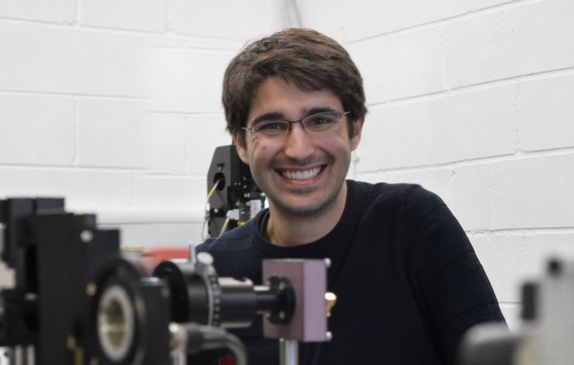 Dedalo Sanz-Hernandez
-
Thomas Schrefl
University Krems
 Klaus Ranger
-
Dieter Suess
University of Vienna
 Philip Heinrich
-
Paola Tiberto
Istituto Nazionale di Ricerca Metrologica, Turin
 ICM2024
-
Christoph Vogler
HUAWEI Technologies Austria
 Christoph Vogler
-
Rikako Yamamoto
ETH Zurich
 Rikako Yamamoto
-
Hyunsoo Yang
National University of Singapore
 Hyunsoo Yang